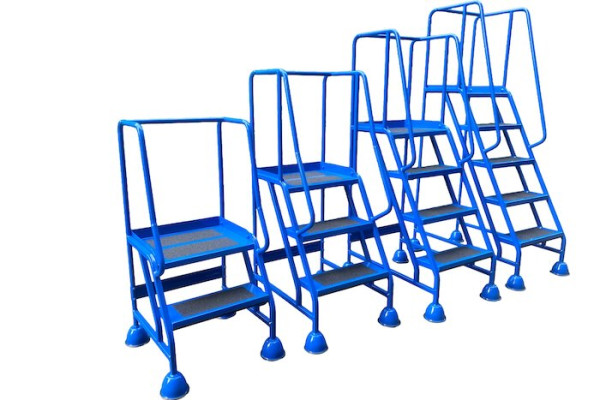
What is a step stool?
A step stool is a low-level step or platform designed to help users overcome small changes in height or reach areas that would otherwise be difficult to access. Step stools are commonly used to assist users in accessing locations just out of reach, such as cleaning shelves, picking up goods or undertaking basic maintenance tasks such as changing a light bulb.
As well as providing a platform for working at height, some step stools can also be used as access steps to help users overcome raised entrances, access modular buildings or reach raised working areas.
The maximum standing height of a step stool, as defined by BS EN 14183, is 1 metre. Step stools are available in a range of designs, including square and circular designs. They can be manufactured from metal or plastic, with metal step stools often preferred for commercial, industrial and outdoor applications due to their robust construction. Some step stools fold for compact storage, while others feature pre-drilled fixing points for securing them in position as permanent or semi-permanent access steps.
What is the standard for step stools?
The standards for Step Stools are outlined in BS EN 14183:2003. The standard covers the definition of step stools, materials they can be manufactured from, slip resistance requirements and test methods.
When choosing metal access steps for use in the workplace, it is also important to consider their intended application, load capacity, stability and suitability for the environment in which they will be used.
What is the maximum height step stools are provided in?
In line with BS EN 14183, the maximum standing height of a step stool is 1 metre. For steps above this height, a different type of access solution may be required, such as a warehouse ladder, folding ladder or a staircase, depending on the design and intended application.
What is the difference between a step stool and a step ladder?
A step stool is designed to overcome lower heights, with a maximum standing height of 1,000mm under BS EN 14183. Step ladders are designed for reaching higher areas and typically feature multiple steps or rungs.
Unlike traditional step ladders, metal step stools and access steps can also be used to provide a stable platform for accessing raised entrances, modular buildings and other elevated areas. Some designs can be secured in position for regular access rather than being moved after each use.
Do step stools require handrails?
Handrails are not always required on step stools, particularly those designed to overcome smaller height differences. However, the requirements for handrails will depend on the height, number of steps, intended use and where the steps are installed. Different regulations and requirements may apply depending on whether the steps are being used as portable equipment or as access steps to a permanent or temporary structure.
It is important to consider the location in which the steps will be used and who will be using them when deciding whether handrails are necessary. Even where they are not a specific requirement, handrails can provide additional stability and support, making them particularly beneficial for users with limited mobility or those recovering from surgery. The Ramp People's Adjustable Safety Step Stool, which is designed for use at heights up to 230mm, is available with or without handrails.
What regulations cover using Step Stools in the workplace?
When considering the use of a Step Stool in the workplace, it is important to refer to The Work at Height Regulations 2005 and the Health and Safety at Work Act 1974.
A health and safety risk assessment should be undertaken prior to using a step stool to ensure it is safe and suitable for the intended application. Consider not only the person using the steps and where they are accessing, but also the surrounding environment. For example, consider whether the step stool may become a trip hazard to others or, where used in a warehouse, whether it is at risk of collisions from forklifts and similar vehicles.
For metal access steps that will be left in position, also consider how they will be secured, the condition of the ground and whether the steps are suitable for the expected frequency of use.
Can the Step Stools be left outside?
Yes, all of The Ramp People's Step Stools are weather-resistant, making them suitable for indoor or outdoor use.
Our metal steps are particularly useful for outdoor access applications, including accessing modular buildings, temporary buildings, raised decking areas and other external entrances.
Can the Step Stools be left in position?
Yes, many of our step stools feature pre-drilled fixing points to allow them to be secured in position for regular or long-term use. This makes them suitable not only for portable applications but also for providing more permanent access to raised areas.
Can the Step Stools be used to provide access to modular buildings and temporary buildings?
Yes. Many of our metal step stools can be used as access steps to improve access to raised entrances and buildings. They can provide a practical solution for accessing modular toilet blocks, construction site offices, raised decking areas and static caravans. For example, our Adjustable Step Stool with 2 steps can be used as a portable step stool to access raised areas in the workplace or it can be used as an access step solution to improve access to raised buildings.
When choosing access steps, it is important to consider the height of the entrance, the available space and whether the steps need to be secured in position.
Are step stools suitable for domestic and commercial use?
Yes, our range of step stools is designed for domestic and commercial use. Depending on the design and specifications, they can be used in homes, gardens, warehouses, factories, construction sites and other commercial environments. They can assist with everyday tasks such as reaching storage areas and carrying out maintenance, as well as providing access to raised entrances and buildings.
What height step stool do I need?
The height of step stool you need will depend on the height you need to reach or the difference in level you need to overcome and the task you are carrying out.
If you are purchasing a step stool for access purposes, measure the height from the ground to the entrance or raised area you wish to access. If you are using the steps for maintenance, stock picking or other tasks at height, consider the height of the area you need to reach, your own height and the additional reach provided by the step stool.
A one-step stool is suitable for overcoming smaller height differences, while a two-step stool provides additional height for accessing higher shelves, storage areas and raised entrances. For tasks that require greater flexibility, a height-adjustable step stool allows you to adapt the step height to suit different requirements.
For undertaking tasks at height, you may wish to consider a step stool with a large step or platform to provide a more spacious working area for completing tasks. For example, our adjustable safety steps, including the two step version, are available with a large or extra-large step to provide a larger area for users to comfortably stand.
What is the maximum capacity / safe working load (SWL) of the step stools?
We offer a range of step stools with capacities up to 400kg depending on your chosen solution.
Always check the safe working load of your chosen step before use and ensure it is suitable for the combined weight of the user and any tools or equipment being carried.
Do step stools have non-slip surfaces?
Yes, our step stools and metal access steps feature non-slip surfaces to provide grip underfoot. The surface varies depending on your chosen step solution. For example, some steps feature a PGR surface, while others have a chequered aluminium surface. These high-traction surfaces help provide grip when using the steps indoors or outdoors.
Can step stools be used on uneven ground?
No, step stools should only be used on flat, level and stable ground. This is particularly important for metal access steps that are being used to provide access to raised buildings or entrances. The ground must be suitable to support the steps and prevent movement during use.
What type of step stool is best for warehouse use?
The best type of step stool for warehouse use depends on the task being carried out and the working environment. For maintenance work, stock picking and tasks that require users to reach higher storage areas, a large or extra-large step stool is often preferred as it provides a more spacious standing platform.
For improving access to ground-level shipping containers, modular buildings or raised working areas, a standard-size step stool may be more suitable.
When choosing a step stool for warehouse use, consider where it will be used (indoors or outdoors), the required step height and the available working space. You should also consider whether the step stool needs to be moved between locations or secured in position for regular use. If portability is important, check the product's weight before purchasing.
Are step stools suitable for accessing modular buildings?
Yes, step stools can be used to improve access to modular buildings, provided the step height is suitable for the entrance and the step stool offers a stable, secure platform. Metal access steps provide a practical way to overcome raised entrances to modular buildings, temporary offices, toilet blocks and other raised structures. Depending on the design, they can be moved between locations or secured in position for regular access.
What are the benefits of a height-adjustable step stool?
A height-adjustable step stool allows you to set the step to a height that is suitable for your requirements. This is particularly beneficial when using the steps to access buildings or raised areas, as entrance heights can vary between locations. Rather than requiring a separate set of steps for each height, an adjustable design can accommodate a range of different access requirements.
Height-adjustable steps are also useful in workplaces where the same steps may be used for different tasks or in different locations.
What is the difference between a standard and large step stool?
The main difference between standard, large and extra-large step stools is the size of the standing platform. Standard step stools provide a comfortable footing area and are commonly used to help users overcome raised areas, access modular buildings or reach slightly higher levels.
Large and extra-large step stools offer a more spacious standing area, making them better suited to tasks that require users to work at height, such as maintenance, cleaning and stock picking. The extra-large step stool features a 1m x 1m platform, providing ample room for users to stand comfortably alongside tools, boxes or equipment.
When choosing a size, consider whether you simply need assistance accessing a raised area or require additional standing space to carry out tasks safely and comfortably.
What are the benefits of metal steps?
Metal steps offer a robust and durable solution for improving access to raised areas in domestic, commercial and industrial environments. They are available in different sizes and configurations to accommodate varying access heights and requirements.
Many metal access steps feature weather-resistant construction and non-slip surfaces, making them suitable for indoor and outdoor use. Some designs also offer adjustable heights and fixing points for securing the steps in position.
What is the difference between adjustable and fixed-height access steps?
Fixed-height access steps are manufactured to provide access at a specific height, making them suitable for locations where the entrance height is unlikely to change.
Adjustable access steps allow you to alter the step height to accommodate different entrance heights or access requirements. They are particularly useful where the steps may be used in multiple locations or where greater flexibility is required.




 Aluminium Retractable Safety Barrier with Reflectors (Expands to 2m)£92.40 £77.00Was £110.00Save £33.00