



Modular Ramps - Rules and Regulations
Modular Ramps - Rules and Regulations
The Modular Ramps (modular wheelchair ramp systems) from The Ramp People has been carefully designed from fully modular components and can be adjusted to suit your needs perfectly, they feature a 5 year guarantee and are tough, durable and most importantly are compliant with Part K & Part M (1 & 6) Building Regulations. But what does Part K & Part M compliance mean? We've tried to break it down as simply as possible.
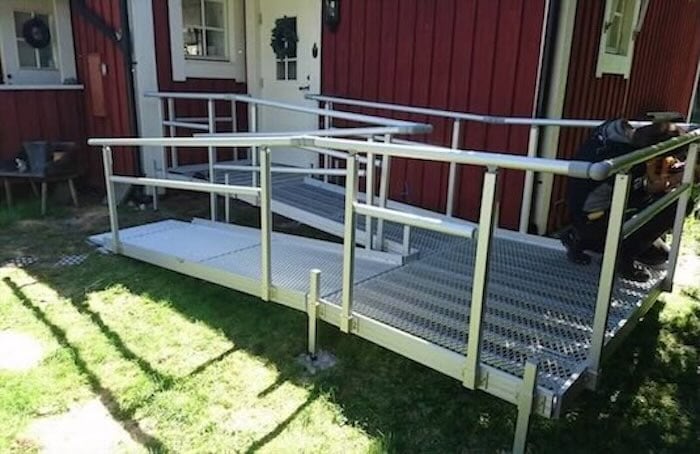
Part M Building regulations - Section 6 Access into a dwelling
Part M of the Building Regulations focuses on ensuring buildings are accessible and usable by everyone, including wheelchair users and those with limited mobility. For ramps, this mainly relates to design, gradients, widths, and safety features.
Design Considerations
- Design Considerations
- (Section 6.9) - It is important that the surface of the ramp approach is firm enough to support the weight of the user and his or her wheelchair as well as smooth enough to allow easy manoeuvre, this should also take the needs of stick and crutch users into account.
- (Section 6.15-a) - The surface of the ramp must be firm and even.
- (Section 6.15-b) - Ramp flights must have an unobstructed width of at least 900mm
- (Section 6.15-c) - 5m systems must not be greater than a 1 in 12 gradient and 10m systems must not be greater than a 1 in 15 gradient.
- (Section 6.15-d) - Top and bottom landings should be at least 1.2m x 1.2m excluding any door swings
- (Section 1.26-f) - The ramp surface must be slip resistant, especially when wet and in a colour that contrasts visually
- (Section 1.26-i) - There should be a handrail on both sides
Handrail Provisions
- (Section 1.37-a) - The Vertical height from the pitch line of the ramp to the top of the upper handrail should be between 900mm and 1m and from the surface of landing should be between 900mm and 1100mm
- (Section 1.37-e) - Handrails should contrast visually with the background against which it is seen
- (Section 1.37-g) - Ends of handrails should terminate in a way that reduces risk of clothing being caught
- (Section 1.37-h) - The handrail profile should be circular with a diameter between 40mm and 45mm, alternatively the profile can be oval with a diameter of 50mm
Stepped Approach
- (Section 6.17-a) - A stepped approach to a landing must have a width of at least 900mm
- (Section 6.17-b) - The rise in a flight of steps should not exceed 1800mm
- (Section 6.17-d) - Step rises should be no more than 150mm and no less than 75mm
- (Section 6.17-e) - Step depth should not be less than 280mm
- (Section 6.17-f) - Where the steps have three or more risers there should be a continuous handrail on at least on side of the flight
Part K Building Regulations
Part K focuses on safety, particularly preventing falls and ensuring safe movement around changes in level.
Section 2: Ramps
- NOTE - Where there appears to be a conflict between the guidance in Part M and Part K, Part M takes precedence
- (Section 1.41) - Guarding must be provided at the sides of flights and landings when there is a drop of more than 600mm. Any openings in the guarding must be under 100mm
- (Section 2.4) - Ramps should be clear of permanent obstructions
- (Section 2.5) - Every ramp with exposed sides should have handrails including up stands at least 100mm from the surface. They should give firm support and allow a firm grip.
- (Section 2.6) - Landings should be provided with handrails
- (Section 2.7) - Ramps and their landings should be guarded at their sides in the same way as stairs
Section 3: Guidance
- (Performance a) - Pedestrian guarding should be provided in dwelling to prevent people from being injured from falling a height of more than 600mm
- (Performance b) - Pedestrian guarding should be provided in other buildings and must prevent people from falling the height of two risers.
- An acceptable level of safety can be achieved by different standards of guarding depending on the circumstances; for example, in a public building the standard of provision may be higher than in a dwelling, this is to reflect the lesser familiarity and great number of users.
Guards and Barriers
- (Section 3.1) - Guarding should be provided where it is reasonably necessary for safety to guard the edges of any part of a floor
Regulations & Helpful Links
Part K focuses on ensuring people are able to access and use buildings and facilities.
Part K building regulations focuses on the protection of buildings.
Referred to in Part M regulations, the standard provides rules for the construction and installation of lifts including ensuring they are accessible to those with disabilities. It is also important to refer to Part 76 which covers evacuations of persons with disabilities using lifts.
British standard focusing on designing accessible and inclusive environments.
Wheelchair Ramp and Building Regulations
- Part M and Part K of the Building Regulations generally apply to permanent wheelchair ramps installed as part of building works. These regulations are commonly relevant for new-build homes, commercial developments, extensions, change-of-use projects (such as converting offices into residential properties), and other situations where Building Regulations approval is required. The regulations help ensure ramps are accessible, safe, and suitable for their intended users.
- The building regulations do not apply to temporary wheelchair ramps, such as folding access ramps which are put in place for an hour or two to provide access to homes or a shop.
Wheelchair Ramp and Planning Permission
- Building regulations are separate from planning permission, and in some cases you may need one, both, or neither depending on the project.
- Planning permission is generally required for certain types of development, such as constructing a new structure, making a significant alteration to a building, or changing the use of a property. For example, planning permission may be needed if you are installing a permanent concrete wheelchair ramp that forms part of a wider structural change to the property.
- Modular wheelchair ramps are typically classed as semi-permanent structures. In many cases, they do not require planning permission or Building Regulations approval, particularly when installed without altering the main structure of the building. However, requirements can vary depending on the location and specific circumstances.
- In some situations, permission may still be required — for example, if the property is listed, located in a conservation area, or subject to other local planning restrictions. It is always advisable to check with your local authority before installation.
Ramp Length Calculator
Building regulations require permanent access ramps to have a gradient of 1 in 12 or 1 in 15 depending on the height of the area and where the ramp is being installed. Utilise our handy ramp length calculator to identify the ramp length you need based on the height of the building entrance.
Need more help? You can use our handy calculator to help calculate the right size wheelchair ramp for your needs.
Wheelchair Ramp Length Calculator
Request a callback
Still need assistance? Our team is available throughout the week to help via phone, email, live chat or WhatsApp. If you’d rather we call you, you can easily request a callback here.
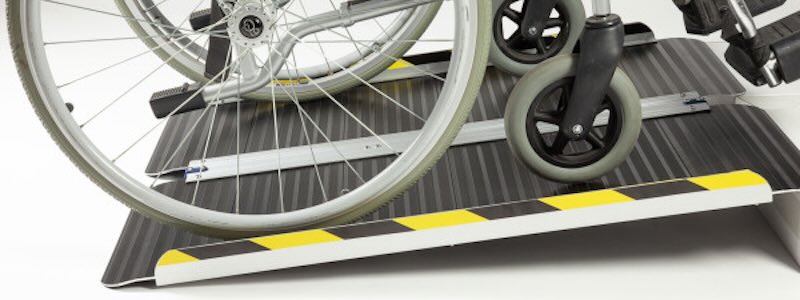
Portable vs Permanent Wheelchair Ramps: Pros and Cons
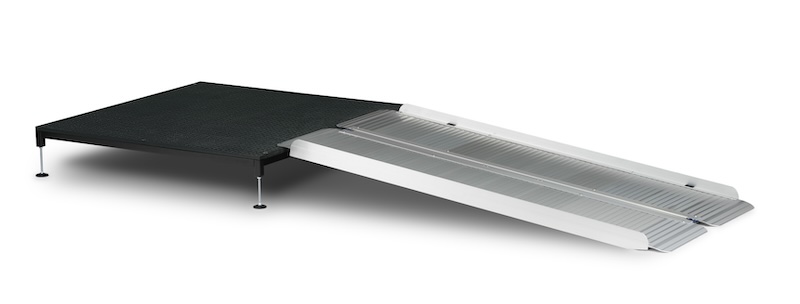
Wheelchair Turning Platforms: Access Solutions for Tight Spaces

How to Choose the Right Wheelchair Ramp for Your Needs
- Categories:
- All
- Vehicle & Plant Loading Ramps
- Wheel Stops
- Workplace Safety
- Speed Bumps
- Accessibility & Disability
- Wheelchair Threshold Ramps
- Truck & Van Ramps
- Cable Covers & Protectors
- Road Safety
- Yard & Container Ramps
- TRP News
- Pet Ramps
- Car Ramps
- Tips and Product Guides
- Customer Case Studies
- Wheelchair Ramps
- Loading Ramps
- Workplace and Health & Safety