



Your Guide to Wheelchair Ramps and Part M & Part K Building Regulations - Modular Wheelchair Ramps
We understand that finding a compliant wheelchair ramp can be confusing, especially with the range of regulations and terminology involved.
At The Ramp People, we’ve created a clear, easy-to-follow guide that brings together the key information you need.
Introduction to our Guide
The following guide is intended to help you understand what requirements you need to meet to ensure your ramp complies to UK regulations. The guide covers the meaning of compliance, and the relevant regulations. The guide will also highlight the key parts of the Part K and Part M (1 & 6) Building Regulations which focus on wheelchair ramps, along with BS 8300:2001.
DDA or Compliant Wheelchair Ramps?
Before shopping for a compliant wheelchair ramp, it is important to consider what is meant by a 'compliant solution'. In some instances, a compliant wheelchair ramp references one which complies with building regulations whilst other times individuals are seeking a DDA compliant ramp.
A wheelchair ramp which needs to comply with building regulations will be a permanent, fixed structure and must comply with Part M and Part K Building Regulations.
Where seeking a DDA compliant ramp, it is important to understand what requirements you wish to meet. Many use the term 'DDA ramp' however the term is outdated. Often it relates to a ramp which complies to the Disability Discrimination Act (DDA). This act has now been replaced by the Equality Act 2010. Where seeking a solution which complies to the Disability Discrimination Act (DDA), or the Equality Act, in many cases you simply need to make reasonable adjustments to ensure your building or business is wheelchair accessible. This may be in terms of a permanent, semi-permanent or portable access ramp solution.
Portable and semi-permanent wheelchair ramps do not need to comply to building regulations as they are not fixed structures. Building regulations are only relevant to fixed parts of the building structure.
If you are unsure as to whether you require a temporary or fixed ramp please contact our team for advice.
Regulations & Helpful Links
Focused on protection from falling, collision and impact, the UK building regulation is designed to protect those using buildings from injury.
Focused on Access to and use of buildings, the UK building regulations focus on ensuring buildings and facilities are accessible.
BS 8300 & BS 8300-1 are standards focused on making buildings accessible for those with disabilities. Whilst not legally binding, it is advised to follow the codes and they are referenced in Part M Building Regulations.
The Equality Act 2010 outlines the requirements to make reasonable adjustments for those with disabilities, including adjustments to buildings to allow those with disabilities to safely access the building.
What Are The Different Types of Wheelchair Ramps
Compliant Ramps

Permanent wheelchair ramps are bespoke and designed for your needs. They are long-term solutions and are built to comply with building regulations. They are provided with dual handrails and turning platforms.
Modular Ramps
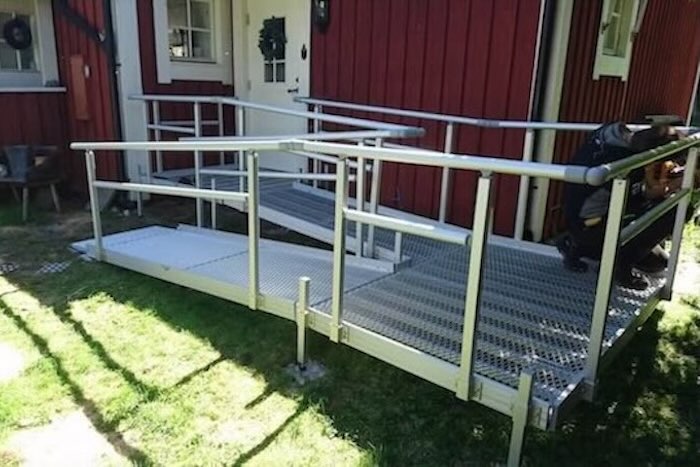
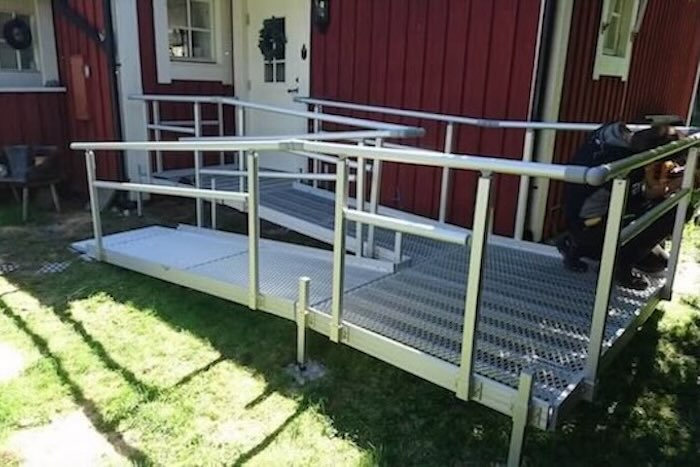
Modular Wheelchair Ramps can be left in place for several months or years. As semi-permanent solutions, they do not need to comply with building regulations. They often include handrails and turning platforms.
Portable Ramps
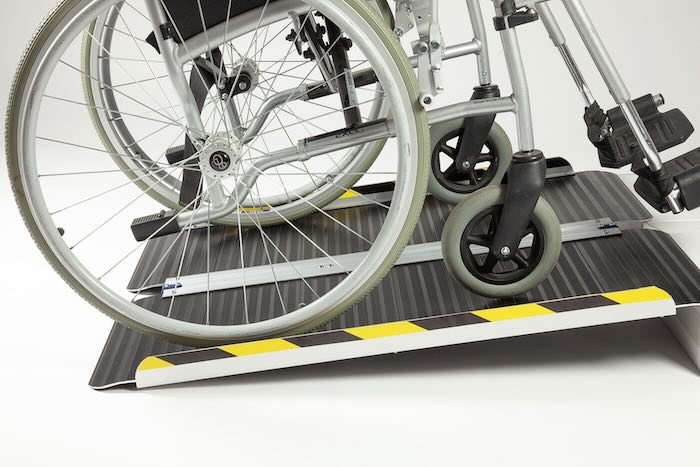
Portable wheelchair ramps range in designs including folding and telescopic solutions. Quick and easy to use, they can simply be put down when required to allow users to overcome steps, doorways and thresholds.
Threshold Ramps

Designed for lower steps heights and kerbs, or to bridge doorways, threshold ramps are quick and easy to set up and simply rest in place. They are made in various sizes and designs including rubber and aluminium solutions.
Building Regulations for Wheelchair Ramps
Below provides details of the key building regulations focused on the requirements for permanent wheelchair ramps.
Part M Regulations
Access into a Dwelling - Design Considerations
This information comes from Part M building regulations: Section 6:
- (Section 6.9) it is important that the surface of an approach available to a wheelchair user should be firm enough to support the weight of the user and his or her wheelchair and smooth enough to permit easy manoeuvre. It should take account of the needs of stock and crutch users.
- (Section 6.15-a) Has a surface width which is firm and even
- (Section 6.15-b) Ramp flights have an unobstructed width of at least 900mm
- (Section 6.15-c) Ramp flights are not greater than:
- 5m at a 1 in 12 gradient
- 10m at a 1 in 15 gradient
- (Section 6.15-c&d) Ramps exceeding these lengths must have a landing
- (Section 6.15-d) Top and bottom landings and any intermediate landings are at least 1.2m x 1.2m exclusive of any door swings
- (Section 1.26-i) There is a handrail on both sides
- (Section 1.26-f) The ramp surface is slip resistant especially when wet and of a colour that contracts visually
Access into a Dwelling - Handrail Provisions
- (Section 1.37-a) The vertical height to the top of the upper handrail from the pitch line of the surface of the ramp is between 900mm and 1m and from the surface of a landing is between 900mm and 1100mm
- (Section 1.37-e) It contracts visually with the background against which it is seen
- (Section 1.37-g) It terminates in a way that reduces the risk of clothing being caught
- (Section 1.37-h) Handrail profile is either circular with a diameter of between 40mm to 45mm or oval preferably with a width of 50mm
Access into a Dwelling - Stepped Approach
Note: Where there appears to be a conflict between the guidance in Part M and Park K, Part M takes precedence.
- (Section 6.17-a) A stepped approach to a landing must have a width of at least 900mm
- (Section 6.17-b) The rise in a flight of steps should not exceed 1800mm
- (Section 6.17-d) Step rises are no more than 150mm and no less than 75mm
- (Section 6.17-e) Step depth should not be less than 280mm
- (Section 6.17-f) Where the step flight has three or more risers there should be a continuous handrail on at least one side of the flight
Part K Building Regulations
Construction of Ramps
Section 2: Ramps
- (Section 1.41) Provide guarding at the sides of flights and landings when there is a drop of more than 600mm.
- (Section 2.4) Ramps should have a slip resistant surface
- (Section 2.5) Every ramp which has exposed sides should have handrails including upstands of at least 100mm from surface. They should give firm support and allow a firm grip, handrails can form the top of the guarding if the heights can be matched
- (Section 2.6) Ramps should be provided with steps where the change in level is 300mm or more
- (Section 2.7) Ramps and their landings should be guarded at their sides in the same way as stairs
Protection from Falling - Performance
(a) Pedestrian guarding is provided in dwellings which is capable of preventing people from being injured by falling from a height of more than 600mm
(b) Pedestrian guarding is provided in other buildings which is capable of preventing people from falling more than the height of two risers. An acceptable level of safety can be achieved by different standards provision for guarding depending upon the circumstances: for example, in a public building the standard of provision may be higher than in a dwelling, to reflect the lesser familiarity and greater number of users.
Who Should I Inform Prior to Installation
If you plan to install a permanent wheelchair ramp which complies to building regulations, it is recommended you contact your local council to discuss the plans with the Building Control and Planning Department and secure planning permission. If you do not own the property you will also need to speak to the landowner or landlord. For listed buildings or building on conservation land, additional permission is likely to be required.
Installation Guidance
For permanent wheelchair ramps, it is recommended that you seek an architect’s advice and arrange for a professional to install the ramp. The requirements of ramps depend on where you wish to install the ramp, for example commercial buildings generally require a smoother gradient than dwellings so it is important the installer has a strong understanding of the guidelines and builds the ramp to the required gradient.
Still Require Assistance? Request a callback
Our team is available throughout the week to help via phone, email, live chat or WhatsApp. If you’d rather we call you, you can easily request a callback here.
For advice on choosing the right modular wheelchair ramp, view our How to Find Your Perfect Modular Wheelchair Ramp guide.