


Container Ramps - Custom Solutions
Custom Container Ramps
The best container ramp depends on what you are loading. A pallet truck requires a very different ramp from a forklift, car or ride-on mower. Before choosing a ramp you need to know the container height, load weight, vehicle ground clearance and how often the ramp will be used.
We offer an extensive variety of container ramps from off the shelf solutions to custom solutions. Our container ramp range includes rubber container ramps, aluminium container ramps and steel ramps. The ramps can be used to easily load forklifts, plant machinery and pallet trucks into containers and over kerbs.

How to Find the Right Container Ramp
The load height is the vertical measurement from the ground to where the ramp will rest. This height will help us to identify the ramp length you require.
Check the maximum weight you wish to load. For example, if you are loading a forklift consider the weight of the forklift and any items you may be loading.
Often forklifts and pallet trucks have low ground clearance. Our container ramps are designed with this in mind however, in some instances further customisations are required to ensure you can safely load items with low ground clearance.
Wide Ramp or Pair of Container Ramps
Before selecting a container ramp, check both the width of the loading area and the width of the equipment you need to load.
f you are only loading a four-wheel forklift, a pair of aluminium loading ramps is often the best option. Individual ramps are lighter than a single full-width ramp, making them easier to position, transport and store.
For equipment with a central wheel, such as three-wheel forklifts, pallet trucks and roll cages, a single wide container ramp is generally recommended. A full-width ramp provides continuous support across the entire loading surface, allowing wheels to track safely regardless of their position.
If you need to load both forklifts and pallet trucks, a wide container ramp is usually the most versatile solution. Products such as a rubber ground level container ramp provide a continuous loading surface suitable for a range of wheeled equipment, reducing the need for multiple ramp systems.
Should I choose a wedge ramp or a rest-on container ramp?
Wedge ramps are a popular solution because they sit directly on the ground and do not place any weight on the container, step or loading area. They are quick to position and simply rest in place, making them easy to use.
As wedge ramps are manufactured to a specific height, they are generally best suited to locations where the loading height remains the same. If you need to use the ramp at multiple loading points with varying heights, a rest-on ramp is usually the better choice, as it can accommodate a wider range of loading heights . It is important to note they do still have a minimum and maximum load height.
Rest-on ramps feature a curved rest-on connection that sits securely on the edge of the container or loading bay. Most models include a pre-drilled fixing hole so the ramp can be secured during loading for added safety. Alternative connection options, such as hook connections, are also available for certain applications.
Aluminium Container Ramps
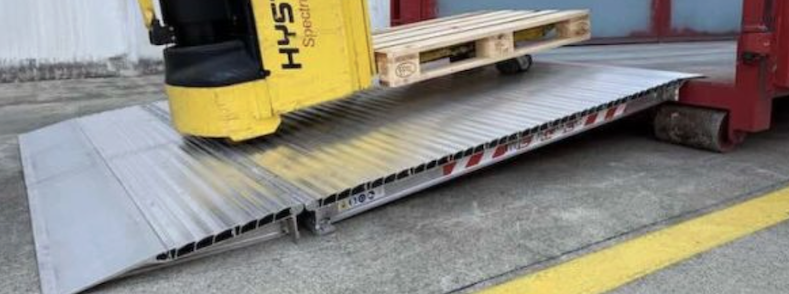
Our aluminium container ramps are supplied as a pair and are available with capacities of up to 7,500kg. TÜV certified for quality and safety, they are designed for loading heights of up to 400mm.
The aluminium container loading ramps are commonly used to load machinery including forklifts into ground level shipping containers to safely load and unload goods or to simply store the machinery in the container overnight.
One customer purchased a pair of our aluminium container loading ramps to load a ride-on mower into a shed. As the loading height was 250mm, we customised the foot of each ramp to ensure it rested securely on the ground, providing a safe and stable loading solution. The finished bespoke ramps can be seen below.
Our aluminium container ramps can be tailored to meet a wide range of requirements. Customisation options include modifying the ramp length to achieve a shallower gradient for low-clearance equipment, adding carry handles for easier lifting and transportation, alternative connection options, bespoke widths and lengths, and raised edges to help guide wheels during loading. The lead time for a bespoke solution is generally 4-6 weeks. We can use a CAD simulation to check suitability prior to purchase. If you have a specific loading requirement, our team can advise on the most suitable bespoke solution.

Pallet Truck Ramps
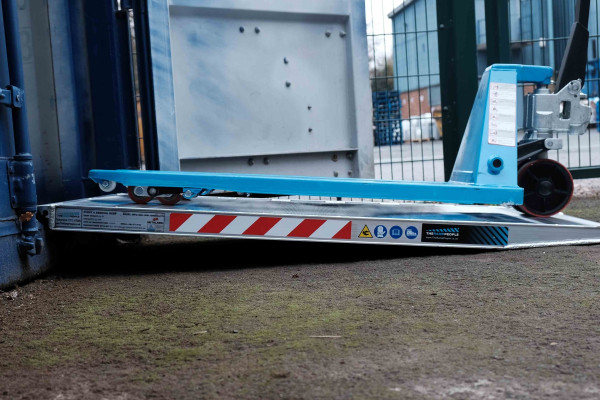
When loading pallet trucks into containers, we recommend our pallet truck ramps which are provided with a 1000kg capacity. The ramps are suitable for heights up to 175mm and can be customised to meet your requirements. These ramps are normally in stock available on a next working day delivery service, custom solutions generally take 4-6 weeks.
Built with the low clearance of pallet trucks in mind, they offer no edges and a smooth gradient to prevent issues with ground clearance. These ramps are often also commonly used to load cages and trolleys over steps and kerbs in the warehouse.
The pallet truck ramps are commonly used in warehouses to safely load goods and equipment over steps and are used by couriers to load pallets over kerbs when delivering goods to kerbside.
We also offer a range of aluminium wedge ramps for pallet trucks.
If you regularly load pallet trucks and forklifts, we would recommend viewing our wide container ramps which are suitable for both types of material handling equipment.

Container Yard Ramp
Our container yard ramp is perfect for loading and unloading containers located on lorries at heights of 800mm - 1650mm. The mobile docking ramps are adjustable in height to meet your requirements and can be provided with handrails for extra security.
The mobile yard ramps are a popular choice for organisations who do not have a loading bay and need to load and unload shipping containers, for example distribution companies who regular recieve and send goods across the UK and Europe.
The ramps can be customised on request, for instance to heave longer connections into the container, please contact our team for a quote.

Container Ramps for Pallet Trucks & Forklifts
Many warehouses need pallet trucks, cages, forklifts and other machinery to be able to safely access ground level shipping containers. We offer a range of wide container ramps designed to cover the full container width which offer a smooth gradient and high capacity to allow you to safely load pallet trucks and forklifts.
The popular modular rubber container ramp is avaiable in heights from 15cm to 30cm. As it is modular, you can create it to a narrower width where needed. For example, some users will use several sections to load cars into containers whilst others wish to cover the full container width to allow forklifts to easily lift goods in and out the container.

Why Does Ground Clearance and Gradient Matter?
A ramp with the correct gradient makes loading safer, smoother and easier. When loading machinery such as forklifts, pallet trucks and scissor lifts, it is important to consider both the equipment’s ground clearance and the maximum gradient it can safely climb. Many types of machinery have low ground clearance, meaning a ramp that is too steep can cause the underside of the machine to make contact with the ramp. This can result in damage to both the equipment and ramp, as well as creating a potential safety risk for operators.
If you are unsure which ramp is suitable for your application, our team can carry out a CAD suitability assessment before purchase to ensure the ramp length, gradient and design are suitable for your equipment.
All ramps on our website have a stated load height or recommended minimum and maximum load height. It is important not to exceed the recommended height range, as the base of the ramp may not sit securely on the ground. If the ramp is not positioned correctly, it may not achieve its advertised maximum capacity and could become damaged during use. A ramp that does not sit flush with the ground can also make loading and unloading more difficult, particularly for equipment with small wheels or low ground clearance.
Common Mistakes When Choosing a Container Ramp
Choosing the correct container ramp is essential to ensure safe and efficient loading. Below are some of the most common mistakes to avoid when selecting a ramp.
Not checking the actual load height
Many customers search for a ramp for a standard ground-level shipping container and use the typical container height when selecting their ramp. However, it is important to measure the actual loading height before purchasing, as containers are often positioned on bearers, blocks or raised ground, which can increase the height from the floor.
If the ramp is selected based on an incorrect height, it may create a steeper gradient than expected and may not sit securely on the ground, making loading more difficult and potentially unsafe.
Not considering other machinery that may use the ramp
It is important to consider both your current equipment and any future requirements before choosing a ramp. While a lower-capacity ramp may be more affordable initially, it may not be suitable if you later need to load heavier machinery.
For example, you may initially purchase a ramp for pallet trucks but later decide to use a forklift. A standard pallet truck ramp may not have the required capacity, width or design to support forklift loading. Choosing a higher-capacity, more versatile ramp from the beginning can often provide a more cost-effective long-term solution.
Not considering the ramp weight
If the ramp will not remain permanently in position, the weight of the ramp is an important consideration. Container ramps often need to be removed to allow the container doors to close, so you should consider who will be responsible for moving the ramp, how frequently it needs to be repositioned and where it will be stored.
Aluminium ramps are often preferred for applications where the ramp needs to be moved regularly, as they provide a high load capacity while remaining lighter than many alternative materials.
Not checking machine specifications
A ramp may have the correct capacity for your equipment but still not be suitable for your specific machine. Always check the ground clearance, wheel size and dimensions of the equipment being loaded.
This is particularly important for forklifts, scissor lifts and other machinery with low ground clearance. A ramp with an unsuitable gradient can cause the underside of the machine to make contact with the ramp, potentially causing damage and creating a safety risk.
About our advice
Our advice is based on over 25 years of experience supplying loading ramps to warehouses, logistics companies, manufacturers, construction firms and private customers across the UK. We provide standard and bespoke container ramps with capacities up to 13,000kg and can carry out CAD suitability checks to ensure the correct ramp is selected for your application. For further advice around container ramps, view our dedicated Container Ramp Buying Guide.
Choosing the correct container ramp comes down to four factors: your load height, the total weight being loaded, the type of equipment being used and how frequently the ramp will be used. Whether you need a lightweight aluminium ramp for occasional loading or a heavy-duty modular solution for daily warehouse operations, selecting the correct ramp will improve safety, productivity and protect your equipment.
Request a callback
View our full range of container ramps on our website or contact our team of advice around the most suitable container ramps for you or to request a bespoke solution.
Our team is available throughout the week to help via phone, email, live chat or WhatsApp. If you’d rather we call you, you can easily request a callback here.




Loading Vehicles Safely: Choosing the Right Equipment for Containers, Lorries and Vans
Heavy Duty Hinged Container Ramp - New Product Alert

Container Ramps Guide
- Categories:
- All
- Vehicle & Plant Loading Ramps
- Wheel Stops
- Workplace Safety
- Speed Bumps
- Accessibility & Disability
- Wheelchair Threshold Ramps
- Truck & Van Ramps
- Cable Covers & Protectors
- Road Safety
- Yard & Container Ramps
- TRP News
- Pet Ramps
- Car Ramps
- Tips and Product Guides
- Customer Case Studies
- Wheelchair Ramps
- Loading Ramps
- Workplace and Health & Safety